Contract Manufacturer vs. OEM: Key Differences Explained
When sourcing manufactured components or finished products, two terms appear constantly in procurement and supply chain conversations: contract manufacturer and OEM (Original Equipment Manufacturer). While they are sometimes used interchangeably, they represent fundamentally different business relationships — and choosing the wrong model can have significant consequences for cost, quality, IP ownership, and time to market.
What Is a Contract Manufacturer?
A contract manufacturer (CM) is a company that produces goods on behalf of another company, according to that client's specifications, designs, and requirements. The contracting company retains full ownership of the product design, intellectual property, and brand. The CM is a manufacturing-as-a-service provider — its value is in production capability, not product development.
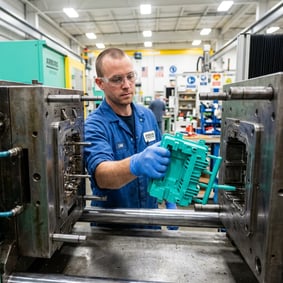
Contract manufacturers operate across a wide range of processes: CNC machining, injection molding, metal stamping, composite fabrication, additive manufacturing, foam and trim processing, and full assembly. They serve clients in automotive, aerospace, defense, medical devices, and industrial equipment sectors.
The defining characteristic of contract manufacturing is flexibility. A CM can produce low volumes with high part variety — sometimes called high-mix, low-volume manufacturing — without requiring the client to maintain their own production infrastructure. This is especially valuable for companies that need certified manufacturing capability (such as AS9100D for aerospace or ITAR compliance for defense) without building it in-house.
What Contract Manufacturers Do Not Do
Contract manufacturers typically do not:
- Own the product design or intellectual property
- Market or sell the finished product under their own name
- Require minimum order quantities on par with Tier 1 OEM suppliers
- Dictate material or process standards beyond what the client specifies
This distinction is critical when negotiating contracts and protecting proprietary designs.
What Is an OEM?
An Original Equipment Manufacturer designs, engineers, and produces a product — or a major component of one — that is sold either directly to end users or incorporated into another company's final product. The OEM owns the design, the tooling, and the intellectual property.
In automotive supply chains, for example, an OEM like Ford, GM, or Stellantis designs and sells the vehicle. In aerospace, OEMs like Boeing or Raytheon own the system-level designs and specifications. Tier 1 suppliers to these OEMs often produce subsystems to OEM-defined specifications — making those Tier 1 companies de facto contract manufacturers in many cases, even when they are also OEMs for other product lines.
The OEM model carries higher upfront investment: engineering resources, design validation, tooling costs, and regulatory certification all fall on the OEM. In return, the OEM captures margin across the product's full lifecycle and controls the roadmap.
Contract Manufacturer vs. OEM: A Direct Comparison
|
Factor |
Contract Manufacturer |
OEM |
|
IP Ownership |
Client retains IP |
OEM owns IP |
|
Design Authority |
Client-driven |
OEM-driven |
|
Brand on Product |
Client's brand |
OEM's brand |
|
MOQ Flexibility |
High (low minimums) |
Often lower flexibility |
|
Certification Requirements |
Varies by CM |
Built into OEM qualification |
|
Capital Exposure |
Lower for client |
Higher for OEM |
|
Speed to Market |
Faster for clients with existing designs |
Slower due to internal development cycle |
When to Use a Contract Manufacturer
Companies choose contract manufacturing when they need production capability without production investment. The most common scenarios include:
New product launches where production volume is uncertain and capital cannot be committed to dedicated tooling and floor space. A contract manufacturer absorbs that risk.
Specialty processes that require certifications the client does not hold — such as ITAR registration for defense-related components or AS9100D certification for aerospace hardware. Rather than pursuing certification independently, companies qualify a contract manufacturer that already holds the credential.
Surge capacity when an OEM's internal facilities cannot meet demand spikes. Contract manufacturers serve as flex capacity without requiring headcount or capital expenditure.
Low-volume, high-mix requirements common in aerospace, defense, and prototype development — where Tier 1 suppliers often decline to quote due to volume minimums. A capable contract manufacturer fills this gap precisely.
When the OEM Model Makes Sense
OEM structures make sense when a company intends to own the product long-term, capture downstream service and replacement part revenue, or build proprietary competitive advantage around manufacturing process. For companies with stable, high-volume demand and the capital to support internal tooling and production infrastructure, vertical integration through OEM manufacturing can improve margin and control.
However, even large OEMs routinely outsource specialty components to contract manufacturers — recognizing that no single facility can economically maintain every process competency in-house.
Hybrid Relationships: Where the Lines Blur
In practice, many supply chain relationships blend both models. A Tier 1 automotive supplier may be an OEM of a particular seat assembly — designing and certifying the system — while simultaneously acting as a contract manufacturer for brackets, stampings, or foam components produced to the OEM's blueprint.
Understanding which role applies in each relationship matters for:
- Intellectual property agreements — who owns the design if tooling is built on the CM's floor?
- Quality responsibility — who is accountable for PPAP submissions and first article inspection?
- Pricing structure — OEM-to-supplier pricing differs from client-to-CM pricing in terms of tooling amortization and NRE (non-recurring engineering) treatment.
Choosing the Right Manufacturing Partner
When evaluating whether to pursue an OEM relationship or engage a contract manufacturer, the decision framework comes down to three questions:
- Who owns the design? If your company owns the drawing and the IP, you need a contract manufacturer — not a co-developer.
- What certifications does the work require? Aerospace and defense programs often mandate specific quality management systems. Verify your CM holds the required registrations before sourcing.
- What are your volume expectations? High-mix, low-volume programs are best served by contract manufacturers with flexible cell-based production — not high-volume OEM lines optimized for commodity runs.
The most capable contract manufacturers combine process breadth with program management depth — handling CNC machining, injection molding, composites, stamping, additive manufacturing, and assembly under one roof, with a single point of contact and consolidated quality documentation.
RCO Engineering is an AS9100D- and ITAR-certified contract manufacturer based in Roseville, Michigan, serving automotive, aerospace, and defense customers since 1973. We produce low-volume, high-mix components and assemblies to customer print — with Tier 1 quality and no Tier 1 minimums.
Comments